Showing posts with label Kerala. Show all posts

Monday, 16 May 2022

When did Christian services start in Tellicherry and its Fort?

Figure 1, St John's Church, Thalassery in 2009.
  Photo courtesy Jissu Jacob


Who built St John's Church at Thalassery?

It is widely believed by many that it was Edward Brennan, the Harbour Master at Tellicherry during the 1860's. This "fact" appears in countless websites, tourist guides, etc. etc. but I believe masks a much earlier series of places of worship on the site.

While it is true that Brennan rebuilt the church in the 1860's, his was definitely not the first church at Tellicherry.

Figure 2. Edward Brennen's memorial plaque
 inside St. John's Church, Thalassery

There are several different Christian Churches in Thalassery today. Each one represents a different form of Christianity, Catholic, C.S.I Protestant, & Basle Mission. All make claims for their foundation dates that are at best questionable, and at worse incorrect.

St. John's Church besides the fort is a Protestant Church. The formal state religion of England had been the Protestant one from the days of King Henry VIII in the 1530's. There were short periods in English history when the Catholic Religion returned during the reigns of Queen Mary I, and King James II, but these were short lived, and most English & Scottish officials will have been Protestant at home before they left for India.

In settlements under the East India Company rule, the official garrison church was therefore always a Protestant Church.  However the East India Company always struggled to recruit enough Protestant men to fill its military units, so that in practise there were often large numbers of Indo-Portuguese, Irish & English Catholics serving in these settlements as soldiers and as lower ranking officials.  These Catholics were accommodated by Catholic Churches, as was the case at Tellicherry, where St Joseph's Catholic Church was built besides the Protestant Church, both within the outer defensive walls of the fort at Tellicherry that we can all visit today.

One of the best preserved monuments & grave stones is that erected (as it would have originally have been set into the ground vertically, is that of Captain Gaspar Moritz Gleetz 1730-1768.

Figure 3. Captain Gaspar Moritz Gleetz 1730-1768

During the middle of the 18th Century there was huge disruption in Germany caused by the many wars that were taking place there. Germany was not a single country, but was dozens of often mutually antagonistic states. Parts of Germany like Hanover were ruled by the King's of England, who ruled both states.  Many German's became full time professional soldiers and officers.

When the British government was mobilising for each new war on Continental Europe, it would need to conscript tens of thousands of often unwilling English, Scots & Irish.  These huge recruiting drives increased competition for the available men in the community.  

Very often a ban was placed on the EIC in London to stop them recruiting in competition with the British Army, and this forced the EIC to recruit in Germany. They had recruiting agents who travelled into Germany, often up the Rivers Rhine, Elbe and Oder in an attempt to find suitable recruits. They were in competition with similar agents acting on behalf of the Dutch VOC, army & navy, who had similar issues finding enough men to fill their armies both in India, the Spice Islands as well as in Europe

Quedlinburg, where Gaspar came from is a town situated just north of the Harz Mountains in Germany mid way between Hanover & Leipzig. At this period many of the officers in the East India Company infantry companies came from Europe where they had often gained extensive experience during the wars in that part of the World.

Figure 4. Childhood home of Gaspar Moritz Gleetz

Modern sources all suggest that Harbour Master Edward Brennan had St John's Church built in the 1860's. This however cannot have been the case as there was a previous church on the site before 1820, constructed by the Reverend Francis Spring, which had been built over the alignment of an earlier wall that encircled the fort facing towards the sea, which had formed part of the defences to the Fort. The fill on either side of the wall had not been adequately compacted on either side of the foundations of the old wall, so that the earlier church broke its back over the old wall, some years before Edward Brennan funded the construction of the current church. 


Figure 5. Location map for Quedlinburg, Gaspar Gleetz home town. The survival of the early gravestone for Gleetz in the graveyard which was set up in 1768 suggests that this area was already consecrated ground by 1768, and possibly much earlier, and that worship was going on close by.

Life expectancy for new arrivals in India during the 18th Century was often less than three years, although those who survived the first three years could stretch to a further twenty years or more in India. Less than 30% of those who arrived from Europe could expect to return there. This means that at least 70% are buried in Tellicherry or nearby.  Somewhere around 10 new people would arrive from Europe each year, sometimes it was more, at other times less. In some other EIC forts like Fort St David, it is known that in the absence of a church, the Gunner's Room was used as a makeshift chapel on the relatively rare occasions that a parson was passing through the settlement or arrived as a chaplain on a passing East India Company ship. Some EIC officers will have taken services  for their men too.

Figure 6. Tellicherry Fort during the latter part of the 1720's preserved at the British Library. The painting was by Samuel Scott, and was one of a number of official paintings done in London which were hung on the walls of the EIC headquarters in Leadenhall Street. Scott had not been out to India, but must have been working from drawings made by an officer on board a visiting East India Company ship. 

Notice the large buildings inside the fort, which have subsequently disappeared. Notice also that there are a number of garden terrace or defensive walls between the fort wall and the sea, in the area where St. John's Church currently stands. It was one of these walls that the Rev. Spring's 1820's church broke its back over. 

The East India Company who arrived at Tellicherry in 1699, were taking over an earlier French settlement that was founded in about 1677 in the area that is now covered by the central bazaar, would have been very wary of worshipping in public, for fear of upsetting the religious sensibilities of both the Hindu's and Muslims.

This concern about Indian objections to Christian religion being outwardly conducted was a very serious, so that the EIC Directors in London made a considerable effort to stop missionaries and clergymen from going out to India.  This policy remained officially in place until the 1830's.

This policy was often deeply unpopular with many of the EIC officials and men who would have attended church services once a week on Sunday every week of their lives. Many will have lived in homes were the head of the family had a bible, and would say family prayers every evening for his family and his servants. 

With death & illness an ever present threat in Tellicherry, many men, especially those who were ill and were close to death will have been very concerned that there was no clergyman to administer to their needs or to administer the Last Rights. Men who were probably not very religious throughout most of their adult life, would suddenly become desperately anxious to be blessed, as it was firmly believed that they would not otherwise get into Heaven.

Christening were not possible, and marriages could not be formally solemnised.

The EIC local employees were however able to get around the official EIC ban or restrictions on clergymen. All along the Malabar coast there were many ports belonging to other countries, or native states, and these ports often had entirely different policies on the presence of priests or parsons in their settlements. Most of these parsons came from Protestant states in Germany, just like Gleetz had. Although they were employed by either the Dutch or English companies, many of these soldiers & parsons were not Dutch or English, but ethnic Germans. 

From time to time one of these Dutch / German missionaries would be invited to Tellicherry were they would give services which the garrison and merchants would attend.

Gunner's were a separate part of the military garrison, and they considered themselves superior to the infantry. They received higher pay, and their NCO's were allowed to distill Arrack which they could retail to the visiting crews of EIC ships anchored in the bay.

They had their own room inside the Fort. The gunners were never expected to leave the settlement, having to live next to the all important cannon, on whose effectiveness the survival of the settlement depended, unlike the infantry who could be sent elsewhere. The gunners barrack rooms were generally much better quality than those allocated to the infantry.  

It is known that at the same period, in other forts like Fort St David's were my 5 x great grandfather Captain John De Morgan (a French Huguenot, who served in the EIC garrison at Fort St David from 1711 until 1746), that officers like De Morgan would hold weekly services for their men inside the Gun Room, in much the same way that Royal Navy officers often do to this day in the absence of a chaplain. 

Figure 7. Captain John Sibbald of the 34th Regiment who died in December 1843 

By the 1780's with the preaching of men like John Wesley, the Established Protestant Church began to reform itself.  It did however split as a result, in the officially recognised church and into the Non-Conformist churches like John Wesley's Methodist Church.  The increased competition from the newer churches caused the Established Anglican Church to have to reform itself, and to reinject itself with new energy.  One of the effects of this reconfiguration of the church in England was renewed pressure on the EIC Directors to allow missionaries and clergy to officially travel out to India directly in EIC shipping. The Reverend Francis Spring was one of the first of these early "official" Anglican Protestant missionaries from this new generation of active and dedicated missionaries and clergy.

Spring was sent to Tellicherry and later on to Cannanore where he played an important role in establishing both of the St. John's churches in those locations. 

Up until about 1812 a substantial garrison had existed in both Tellicherry and Cannanore. By 1815 it appears that a decision was taken to move the army out of Tellicherry to Cannanore, where the existing site and fortifications could more easily accommodate the garrisons and prisons required.

However, the judicial community that was living in large comfortable house that they had built or acquired in Tellicherry were very reluctant to follow the garrison to Cannanore. It is believed that only about seven judicial officials remained in the town plus the harbour master by 1818.

We believe that Spring had arrived in Tellicherry in about 1817, and that he set about building a new church on the site of the former much older (1720?) garrison graveyard. This was to replace the old "Gun Room."  As Tellicherry was rapidly emptying of the churches potential source of a congregation, the raising of funds and the construction of the church may have taken a while, and the work may have been carried out in a less than competent manner. This may account for the fragile nature of the structure.

At the mean time the garrison at Cannanore probably numbered in excess of 500 European men, and needed a church of its own. The Rev. Spring became involved in promoting that church as well.

Spring himself appears to have left both Cannanore & Tellicherry during 1823 heading home to England. Responsibility for his churches was transferred to the Church Missionary Society [CMS], who subsequently supplied funding an clergy from England. Some of their reports are now available online dating from the 1820's, and I will explore those in later posts. 

As many of you are aware I have had an interest in the Thalassery and surrounding districts including the Wayanad for many years, and this has led to my becoming a focal point of contact for many other people who have similar connections with the town and the surrounding areas. 

Over the years these people have included former sepoys, teachers, bakers of the famous Victoria sponge cake, Mappila merchants, temple authorities as well as the descendants of former EIC officials and army personnel who served there over the years. 

Recently I have become involved in an informal project locally to try to improve the condition of several of local heritage sites in the town, which is succeeding in drawing a much greater of level of interest in Thalassery & internationally has been much than I had originally been expecting. 

 As I was taught at school, Brutus said to Cassius in Shakespeare's 'Julius Caesar' 

“There is a tide in the affairs of men. Which, taken at the flood, leads on to fortune” 

Whilst I have not been a great fan of Shakespeare since I left school,that quotation has remained a very effective maxim to deploy in my subsequent life. I want to see if I can build on the momentum that people like Biju Thomas have been very successfully building up locally, especially as I have been getting a lot of very positive responses from the local community in Thalassery. 

I am trying to get into a position to hold a series of launch events in the autumn of this year, or January 2023, when I hope to be in the town for several weeks, working on my own research projects.
Figure 8. Catherine Maitland, wife of John Vaughan 1833.

Vaughan was the Principle Collector at Tellicherry throughout most of the 1820's and 1830's.

 Figure 9. A close up of the plaque on Catherine Maitland's tomb.
                               
One of the key sites that can be visited today is the former Protestant garrison church at St John’s Tellicherry. This church is sandwiched between the old East India Company Fort and the sea. When I was last in Tellicherry in 2006, it was in an appalling state.

Fortunately, in 2009 the local church and community authorities undertook a very thorough restoration of the structure of the church itself. This work is described in the following two blog posts that I made in 2009.

http://malabardays.blogspot.com/.../tellicherry-church...
and
http://malabardays.blogspot.com/.../tellicherry-church...

Since 2009 the church has had a number of further restoration efforts made, and the grounds have been maintained periodically.

Figure 10. Cecilia Lawrie's Tomb

The numbering on the tombs in red had been applied to many of the monuments and grave stones by 2009. The highest number that I am aware of is about 50, but the person who took this photo told me that he believed that there had been far more gravestones in the graveyard orginially, but that only the most robust ones had been numbered.


Figure 11. St John's Church under restoration in 2007.
Photo by Lindsay Gething.

The next door school, St Joseph's Higher Secondary School, Thalassery which has origins as an Anglo-Indian school going back to the 18th century, and which is run under the management of Latin Diocese of Kannur, has taken an interest in St John’s Church which is located in the heart of the town of Thalassery beside the original Tellicherry Fort.

The Bishop of CSI church for North Kerala Diocese has recently expressed his interest in the project and wishes to talk about how to ready the British Heritage assets in his churches for the proposed north Kerala tourism development in a way that would be helpful to the society and his community Members. Depending on the response from interested parties, we might try to develop a process to roll out our project to encompass other nearby churchyards from other denominations. If you have connections with Tellicherry or have ancestors buried in these churches, and feel that you might like to take part please email me at balmer.nicholas@gmail.com

Figure 12. Eliza Wills, wife of Henry Crewe
who died at Tellicherry in 1874


At present I have no knowledge of Henry Crewe's life. Does anybody know anything about him?
Figure 13. James Ward Esq, Indian Navy

It is hard to be certain which part of the Ward family this man came from.  There are several references to a Lieut. Ward in "The History of the Indian Navy 1613-1863" by C. R. Low, which suggest that Lieut. Ward had spent a lot of time as a marine surveyor in the Bombay Marine off Socotra and Aden at the mouth of the Red Sea.  Surveying the shores of the Indian Ocean was a very important part of the work of the Indian Navy at that time.

As they approached retirement age, many former Indian Navy officers left their ship based activities for shore based posts and became Harbour Masters, so it is entirely possible that he was Harbour Master at Tellicherry at some point between Mr. Oakes and Mr. Brennen who were also Harbour Masters at Tellicherry.  C.R. Low also mentions a Lieutenant C.Y. Ward, who compiled the "Gulf of Aden Pilot" published by the Admiralty in 1863. He might be either James Ward's brother or even son.

Many people who had become seriously ill in other parts of India or the Indian Ocean, made sea voyages to Tellicherry from places like Bombay. The voyage alone was believed to be good for you, and was often prescribed by Company Doctors, and the voyage often cured many illnesses.  Tellicherry had been seen for many years as being a particularly healthy station compared with most other coastal EIC port settlements.

As Ootacamund developed into a summer hill station by the 1840's, many people from places like Bombay who were already ill travelled via Tellicherry or Cannanore to Ootacamund via the Wayanad, and their letters and diaries often contain some of the best descriptions of the Tellicherry area at that time. It is possible that James Ward had been passing through Tellicherry when he died.
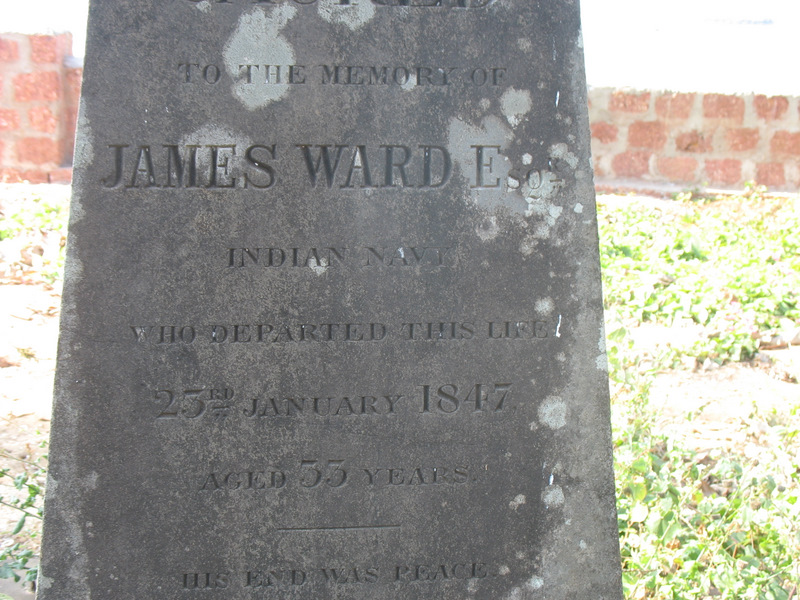
Figure 14. A close up shot of the inscription on James Ward's monument

Like so many children, Elizabeth Schmidt had died aged just 10 months and 15 days old in 1822. One can only imagine the heart ache at this gravestone for her parents.


Figure 15. Elizabeth Frances Schmidt.  Schmidt is a German name that means smith.

Many earlier tomb stones have probably crumbled or been pushed aside in recent years.

Figure 16. James Crawford (possibly). 
He may have been related to Mr H Crawford who was Commercial Agent
 for the Travancore Government at Alleppey


Figure 17. James Stevens, who was the senior judge
 at Tellicherry in the early 1800's.

James Stevens played a very important role in leading the establishment of EIC law the former local rulers estates in the aftermath of Tipu Sultan's invasions. Under huge pressure to deliver, inadequate numbers of staff and with the Pazhassi Rebellion under way at the time it must have been a tough assignment. My 4 x great uncle Thomas Hervey Baber was 3rd Judge at the same time that Stevens was 1st Judge. They were of very different generations and mindsets. They did not get on very well at times.

Figure 18. James Stevens grave monument.

James Stevens modern descendants live in Australia, some of them visited this tomb about a decade ago. The dark stain was caused by the use of water to try to make the text readable. It will have dried away shortly afterwards.  You can see how the heavy rains and sun are taking the toll of the chunam plaster exposing the laterite blockwork underneath.

Figure 19. Margaret Eleanor John, who was born in 1837 and died in 1911.


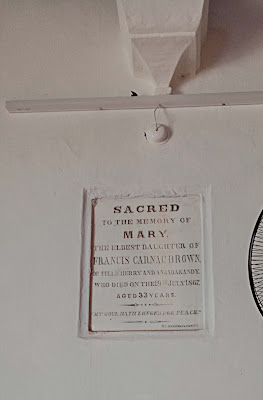
Figure 20. Mary Brown, daughter of Francis Carnac Brown. This photo dates from quite recently, and shows how it was over painted in recent years.

Mary Brown's grandfather Murdoch Brown had been a really colourful character whose life would make a good film or novel. He bought a lot of slaves at Alleppey from local slave dealers, for use to cultivate his new plantation at nearby Anjarakandy. 

Figure 21. This was Mary Brown's plaque a few years earlier.
It is a great pity that it was painted over. I wonder if the paint could be removed?


By seeking to use slave labour in 1797, Murdoch Brown was following centuries old, local custom and practice. 

Thomas Baber who had only relatively recently arrived from England where he appears to have absorbed the early campaigns of anti-slavery campaigners of the Clapham Sect. He went on to take out a private prosecution against Brown in the Madras High court. 

Brown organised for an army officer (with a severe debt problem, and a reputation for fighting duels to try to pay off his crippling debt.) called Billy Robinson to challenge Baber to a duel that was fought.

As a young officer Francis Carnac Brown also challenged Baber to a duel a couple of years later. Brown and his two accomplices were prosecuted, again privately in Madras, and to the disgust of many in court Thomas Baber secured a successful prosecution, sending Brown and the other two to prison.

Francis Carnac Brown seems to have quickly recovered from his time in prison, and as an older and no doubt wiser man, he went on to play a major role in establishing planting in the Wayanad and elsewhere. He wrote several really interesting books on planting & other issues facing EIC expats in late 1830's Kerala.

One can only imagine what the scene was like in this church with the Brown family sat in one pew and the Baber family nearby in another pew.

Figure 22. Patrick Henry Gordon who died in 1876. A planter, Patrick appears to have made it back to Acton to the west of London, where he died and was buried in Kensal Green Cemetery.  It is evident that his former fellow planters regarded him highly enough to put up a plaque in St John's Church.

Does anybody know where Polly Coon was in Tellicherry?

Figure 23. St John's Church Tellicherry in 2006-2007

This was the state of St John's Church when I visited in in 2006. At that time I though that the church was probably beyond recall.

The growth of scrub in the grave yard was chest high when I climbed into the grave yard. The place was full of mongooses, and my dear local host was beseeching me to get out of the graveyard as fast as possible, as it must be full of snakes to be able to support so many mongooses.

Thankfully the community at Thalassery have taken substantial steps to look after this church in recent years, and they should be thanked for having done so much to preserve this part of our shared heritage.

Especial thanks are due to Dr. Denny, the Principle, and the pupils of St. Joseph's Higher Secondary School who are looking after the graveyard currently.

Figure 24. Here is one of the other tombs but sadly the inscription is not readily seen in this photo.
The church under restoration in 2009 can be seen in the background.
Note the amount of rubble from tumbled down tombs lying around.


Sunday, 5 March 2017

Cannanore Fort, a discussion over it's development . Part 1.


Figure 1. Cananoor during the Dutch Period. [1] Please click on the image for a larger image.

The following article is an attempt to respond to a call for help from Sujith Kumar, a member of the Kannur Tourism Police who works at St Angelo Fort in Kannur. Sujith has developed a very good knowledge of the forts history and is trying to collect more detailed background to the forts history.


 Figure 2. 2009 Google Earth Image of St Angelo Fort. Please click on image for larger version.

He regrets however his inability to access original sources of research material, and especially archives from the British period of the forts history. He asked if I had any knowledge of the existence of any maps or drawings from the period? 

Could I help?

A number of maps and drawings survive of the fort at Kannur from the Portuguese and Dutch periods.  [2] 

An particular good one was drawn by Bellin and appeared in several 18th century books including J Van Schley's work of 1760. This is shown in Figure 1. above.

By comparing the 2009 Google Earth image in Figure 2 with the 1760 Dutch plan in Figure 1, it is easy to determine the extent of the Dutch and earlier Portuguese Fort, which is situated towards the end of the promontory. Apart from the later land filling into the bay on the eastern side of the fort, the area is very little changed since 1760, so where was the British Fort situated?

We know that the East India Company [EIC] spent a very large sum on the fort in the years after its final capture by Captain Wiseman, part of General Abercromby's force on 16th December 1790?[3]

In 1796 Walter Ewer, an EIC official from Bengal visited the Malabar and wrote a series of reports to Henry Dundas back in London. [4] The Right Honourable Henry Dundas (1742-1811), was War Secretary in William Pitts Cabinet from 1794 to 1801 and was also responsible for the colonies.

Ewer wrote the following from Tellicherry.[5]

"Cannanore.  Very expensive works are carrying on at this place, tis said they will cost two lacs of Rup's & that when finished they will be useless, being commanded by high ground. I am told it is proposed to level this, the expense of which would be many lac.  One half of the money expended at Tellicherry wou'd make it a strong place, besides here are storehouses, & magazines, & some thousand militia can be raised in case of need.
I mention this on the authority of the first Military Character in the Country." 

The first European fort at Cannanore had originally been built by the Portuguese, and was indeed one of the very first forts that they built in India.  The Portuguese had intended to trade in India and were well informed about the potential locations where the trade took place in India before they had first arrived off the coast.

The first voyage had been intended for Calicut to trade with the subjects of the Zamorin. At this period Calicut was the prime trading location, but it was also very closely connected with the Arab trading system to the Gulf, and it was this same trade that the Portuguese were attempting to redirect via Lisbon. So from the first the Muslim merchants quickly realised that the Portuguese had the potential to destroy their livelihoods.


From the earliest days the Portuguese had had relationships with the Kolattri Rajah. At first this was limited to leaving goods and merchants at the settlement. However King Emmanuel of Portugal decided to send out Don Francisco de Almeyda as his first Viceroy of all the Indies. His appointment on the 25th March 1505 included instructions to built forts at Anjediva Island, Cannanore, Cochin and Quilon.

His fleet arrived at Anjediva on the 13th September 1505 and a fort was commenced straight away.  Leaving a garrison on the island De Almeyda sailed south to Cannanore arriving on the 23rd of October 1505.  He landed Lorenzo de Brito with one hundred and fifty men to construct the fort, and two ships to be used to guard the site and to patrol out to sea. These were not the only Portuguese at Cannanore, some two hundred had been left behind in December 1502 by Da Gama, and some of these had probably survived.


Figure 3. Showing the fort before 1572.[6]

The first fort was probably just a palisade and ditch across the promontory. This was probably soon replaced by stone. The site is built onto a rocky outcrop and the underlying rock of a very soft red ironstone like material that hardened after exposure to air.


Figure 4. Google Earth Image marked to show suggested locations
of the Portuguese walls.
Please click on image for larger version.

The first fort was soon under attack. The Zamorin had wide spread contacts across the Muslim World and the attacks of the Portuguese pirates and fleets in the Indian Ocean was beginning to threaten the long established trading routes from India through the Arabian Gulf and the Red Sea. Communities like Muscat, Aden, Alexandria and Damascus and even Istanbul and Venice were suffering shortages of goods.

Ambassadors had travelled to Egypt and Istanbul to request help to rid the Ocean of the Portuguese. Preparations were commenced in Egypt to prepare a fleet to sail to India to attack the Portuguese. Aware of how marginal their hold was in India the Portuguese decided to abandon the Fort at Anjediva, and to concentrate at Cannanore and Cochin.

Lorenzo Almeyda brought his fleet to Cannanore on the 16th March 1506, and was soon faced with a huge enemy fleet of about two hundred and ten ships, including ones crewed by Ottoman Turkish troops. The Portuguese had of course had experience of fighting Ottoman troops before, and this was going to be far tougher than fighting the local Indian troops. A tremendous battle at sea took place in the bay immediately south of the fort.  Eventually the Portuguese cannon prevailed against the allied fleet.  It retreated towards Dharmapattanam as it tried to retreat, but a strong wind got up driving back towards the north.

The Muslim fleet sent messages to the Portuguese asking to be allowed to sail north unmolested, put the Portuguese refused and attacked again causing over three thousand casualties in the Muslim fleet.

Unable to prevail by sea, the Zamorin and the local Muslim's put sufficient pressure on the new Kolattiri Raja that he deserted his former allies, the Portuguese.  Da Gama's former friendly Kolattiri having died, and the Portuguese had abused the Rajah's subjects by taking their ships and possessions.

Gonzalo Vaz had captured a ship near Cannanore with passes, which he claimed to be forged, plundered the ship and then had murdered the crew who were sewn up into a sail and cast into the water. The bodies had floated ashore and included those of the son in law of Mammali Marakkar one of the most important local merchants. After confronting Lorenzo de Brito to demand recompense, receiving an unsatisfactory reponse the merchant when to the Kolattiri Rajah with many supporters, and the Rajah agreed to go to war with the Portuguese.  From the 27th April 1507 the fort came under siege.

The Rajah's obtained 21 cannon from the Zamorin, and forty thousand Nairs were believed to have arrived to fight in the seige. This seems unlikely due to the size of subsequent armies, but it is clear that a substantial force was involved. The Zamorin sent twenty thousand more men to assist.

Many assaults were made, and it was at this point that it became apparent that the Portuguese had made a fundamental error when they had designed the fort.  The only well was situated a" bow shot" from the wall on the enemy side of the walls. Every time the Portuguese needed to draw water they had to fight for it.

This suggests that the first wall in Figure 4 above was along the line of the defences in 1507.

Eventually an engineer called Fernandez came up with the idea of driving a tunnel through the soft rock under the wall and into the shaft of the well. They were then enabled to draw water without exposing themselves.

Most of the surviving Portuguese had been wounded at least once and food was running out. Miraculously on the 15th August 1507 shoals of crabs and prawns were swept ashore by the tide, and the garrison was able to re-supply itself. 

The siege went on until 27th August 1507 a relieving fleet of eleven ships under De Cunha arrived with three hundred men from Europe and were able to drive off the besiegers.

During the siege the fort had been very exposed to fire from the higher ground to the north, and this was to be an issue for the rest of its existence as an active garrison.  The attackers had used bales of cotton to raise themselves up above the height of the walls so that they could fire into the interior of the fort.

As result of the experience of this siege, and in order to enclose the well and to increase the defences it was probably decided to build a second wall in Figure 4 was built outside the first wall.

The drawing in Figure 3 was published in 1572, and it shows only one wall. However the map was probably drawn many years before the print was published.

Figure 5 below comes from a Portuguese Atlas published in 1630. It is likely however that the drawing from which the engraving was done was drawn much earlier.  The text refers to events in 1567, so although the date below the fort says 1505 it refers to the founding of the fort, and not the date of the map.

As the map shows a second wall and refers to events in 1567 it suggests that the second wall pre-dates 1567.


Figure 5. Portuguese atlas, 1630.
Please click on image for larger version.

In figure 5 a town can be seen to have sprung up outside the fort itself. This town was probably under what is now the Dutch fortress. It appears to extend into the older Indian town, although there is still a substantial suburb outside the walls. This suggests that the town was segregated into several communities, Portuguese, Indo Portuguese and the Muslim subjects of the Ali Rajah.

It is interesting that the guns are shown facing out to sea. This is clearly where the greatest perceived threat was seen to lie. By the 1630's Dutch & English ships were beginning to pose a serious threat to the Portuguese settlements, and this threat is probably why these cannons have been mounted facing out to sea.

This poses an interesting question. Was the Portuguese printer re-using an older engraving and had he decided to re-engrave it to show the situation in the years leading up to 1630, when the Dutch and English shipping arriving in the Indian Ocean had become a very real threat to the Portuguese possessions?

Figure 6. Map of the fort and town of Cannanore shortly 
before about 1632
during the Portuguese period, from the
Livro das Plantas de todas as fortalezas, 
by António Bocarro. [Click on for larger image]


Figure 7. Google Earth Image marked up with suggested
extent of the Portuguese settlement before it's destruction by the Dutch.
[Click on image for larger version]

Working from Figure 6, and by using proportions, it is possible to mark up a modern satellite photo with an approximate line of where the two outer suburbs of the Portuguese settlement might have been situated.

Ancient property boundaries are often preserved long after the original reasons for their existence has gone.

I believe that the northern boundary of the Portuguese settlement where it met the territory controlled by the Ali Rajah or Bibi of Arrakal has been preserved down to the present day along the route taken by the Portuguese Walls. There was probably a ditch between the wall and the edge of the Arrakal settlement.

The original Portuguese fort was quite small, and would only have had a limited garrison. This would have required the fort to be built with as short a set of walls as possible.  During the siege it had become apparent that these walls guarded too small and area of ground, leaving the access to the well exposed.
A second set of walls was built, enclosing the well.

As the settlement grew the population increased and required more space for housing.

Most of the new population will have been Indian's or the offspring of Indo-Portuguese marriages or concubinage. These offspring may have been regarded as insufficiently trusted to be allowed to live in the fort itself, but had to be provided with protection, so that the outer township developed within a third set of walls.
By inspection of spot heights on Google Earth it appears that the average elevation of the fort was 8 metres above sea level. The land rises up to about 15 metres above sea level to the north.

Initially this had not mattered as the potential Indian adversaries had only limited access to cannon. They were unlikely to have weapons capable of doing serious damage to the fort walls.

However, as the 16th Century wore on cannon became both more numerous and  effective. The advent of Dutch and English shipping in the area opened up the possibility of attacks on the original fort from the north.

The outer wall in Figure 7 sits almost exactly at the top of the slope climbing up from the fort. By having an outer wall and suburb the Portuguese had strengthened the original fort.

For most likely scenario's against Indian forces the Medieval style walls would be sufficient against most attacks.

In the event of an insurrection amongst the Indo-Portuguese, or a successful attack on the town, the Portuguese themselves could fall back onto the fort, to await rescue by sea from one of the other settlements.

Figure  8. Portuguese Map of Cananor town.
from Plantas das Cidades de Fortalezas
da conquista da India Oriental by 
João Teixeira Albernaz circa 1630
[Click on image for larger version]

I have been unable to date the map of the town of Cannanore shown in Figure 8, which appears to show an earlier fort inside the town lived in by the Ali Rajah's subjects, that pre-dated the arrival of the Portuguese.

This fort might have belonged to this family, or it may have been a trading post inside the town.

It was quite common for map makers at this period to re-engrave using information from much earlier maps.

I believe that it is just possible that this map may show the situation in the period not long after the Portuguese arrived, and before they became sufficiently powerful to overawe the Muslim rulers into allowing them to extend their settlement from the fort and to build walls that run out towards the existing settlement.


Figure 9. Google Earth Image showing the same area
that is shown in Figure 8. above. The modern town
appears to have much the same street pattern as the
16th Century one.
[Click on image for larger version]

If you have access to Portuguese or Dutch material about the fort at Kannur, I would be very pleased to hear from you. It is quite possible that I have missed important points, or may have misidentified maps, ad dates of maps. If you can narrow down the dates or origins of these maps, I would be very pleased to hear from you.

It is unlikely that very much remains of the original Indo-Portuguese town that was demolished by the Dutch. This would be especially true close to the old fort, because it is known that the area was scarped and re-worked both by the Dutch and later British to clear fields of fire.

It is also very probable that the fabric of the old Portuguese walls was robbed out to provide materials for later building works. It would still be very interesting to field walk the area to the north and east of the site old town, as it is quite possible that demolition materials, debris and the remains of buildings may remain at or near the surface of the ground.

As it is quite likely to be several years before, I am able to go back to Kannur, I would be fascinated if you are able to find remains.

In my next blog I will go on to explore the Dutch period of occupation of the fort.


[1] Bellin's plan of Cananore, by Prevost, from Frances Pritchett's website. [http://www.columbia.edu/itc/mealac/pritchett/00routesdata/1700_1799/malabar/cananore/cananore.html
[2] See the following website for a particularly good collection http://www.columbia.edu/itc/mealac/pritchett/00routesdata/1700_1799/malabar/cananore
[3] Malabar Manual, by William Logan, volume 1, page 443.
[4] IOR H/438 Papers of Walter Ewer.
[5] IOR H/438 folio 147.
[6] Source: http://historic-cities.huji.ac.il/india/cannanore/maps/braun_hogenberg_I_54_3.html
(downloaded Feb. 2006)
"From Braun and Hogenberg, Civitates Orbis Terrarum I 54. Date: first Latin edition of volume I was published in 1572. After: an unidentified Portuguese manuscript."
[7] From Biblioteca Pública de Évora's photostream, see http://www.flickr.com/photos/bibliotecapublicaevora/ which contains many very interesting maps of forts in Asia during the Portuguese colonial period.

Sunday, 27 November 2016

Helen Baber, her life & final resting place


Helen Baber's grave stone, the English Church, Tellicherry. 
Photo courtesy of Jissu Jacob.


Throughout much of history there have been strong wives who have supported their husbands through thick and thin. These husbands would not have been nearly as effective as they were without their wives.

It is quite clear that Thomas Hervey Baber, was extremely fortunate in his choice of wife, and that Helen Somerville Baber must have been a remarkable woman in her own right.

Like so many of these wives, however it is extremely hard to discover their complete story because she was essentially a private person in the manner of those days, and one who was hidden away from sight. She only very rarely appears in the official records, and then we only occasional catch tantalising glimpses into her life. Yet when she does enter the records, the strength of her character, and the enduring nature of her love and support for Thomas Baber comes though very clearly.

Thanks to a great deal of good luck, and a great deal of kindness on the part of Jissu Jacob a local man from Periah, Helen has suddenly been brought into view.


View of Helen Baber's table tomb, in the newly cleared church yard.

On my visit to Thalassey in 2006, I had been so overwhelmed by hospitality, that I had run out of time for adequately exploring the town. Reaching the fort as dusk fell, and only able to view over the fence into the overgrown churchyard as dusk was falling, I had feared attempting to climb into the churchyard, lest I fell down a hole, or encountered a snake.

As a result of this blog, I have been having a substantial correspondence with quite a few local people from Kerala and especially Thalassey. One of these Jissu Jacob, a local historian and tour guide was good enough to go recently to the churchyard and to take the photos in this post.

We know very little about Helen Baber's early life beyond the following passage in a note book kept by my great great great grandfather Henry Hervey Baber, Thomas Baber's elder brother.

On February 7th 1798 Henry in England, records that his father had received the following letter from his brother: -

“Feb. 7 Father hears from Tom -- Letter dated Bombay August 1797 – about the same receives a letter which came overland enclosed (by just favour) with government dispatches, requesting his consent to marry a Mrs Cameron (wife of a Major Cameron who was lately killed in an excursion down the country) she is not 18 the daughter of Mr. Fearon of Edinburgh & niece of Mr Douglas of Fitzroy Square London. She had been married to the Major about a twelvemonth.
[1]

Thomas’s fiance, whose maiden name had been Helen Somerville Fearon, had previously been married during 1795 at the age of only 15 to Captain Donald Cameron, of the Bombay Army at Portsmouth. With the East India Company recruitment camp on the Isle of Wight nearby, this many have been a last minute affair prior to Cameron boarding an East Indiamen before setting out on the long journey east.

It had not been uncommon for girls, especially daughters of soldiers aged 15 or less to marry soldiers during this period, however it was much less common for officers to marry such young girls. Her father came from Edinburgh, and one wonders if she had perhaps run away with the Captain.

Following her marriage, she must have almost immediately boarded the East Indiaman for the voyage to India. One can only imagine what it must have been like for a teenage girl, who would still have been at school had she been born today. She would have travelled in a tiny cabin constructed towards the stern of the ship, divided from her fellow passengers by temporary timber and canvas curtains.

The ship would have been crammed full of soldiers, sailors and fellow travellers.

Conditions on-board would have often been cold, wet, and the air fetid with the smells coming up from the other decks. The relative seniority of her new husband probably meant that she ate with the ships captain and the other senior passengers in captains stern cabin. She will have been able to visit the upper deck for exercise, where no doubt she would have been an object of curiosity to the sailors.

The war with France was raging, and Britain had not yet achieved naval supremacy, so she faced not just storms and the possibility of shipwreck, but also capture by the French.

Helen will have arrived in India during 1796, probably arriving first and Surat where her husbands Battalion was stationed.  Very soon after her arrival, the Battalion was mobilised to proceed to Tellicherry. Presumably Helen travelled on with the Major to Tellicherry. Given the smallness of the fort, at Tellicherry, it is quite possible she lived in tents with the Major. However, she was not to experience married life for long, for hardly had she arrived in India than she had become a widow.

Major Cameron was killed on the 18th of March 1797 whilst fighting his way down the Periah Pass. (See http://malabardays.blogspot.com/2006/12/death-of-major-cameron.html )

One can only image the pain and grief that she must have experienced at that moment, on learning that her husband was missing and was believed to have been killed.

One can only imagine how frightening, must have been her situation, she was only 17, widowed. She was in a foreign town thousands of miles from her family, and she was dependant on the charity of others.

It is not clear how Thomas first met Helen Cameron. However it is very likely that she was staying either in Tellicherry, or at Cannanore with its fort and cantonment.

As Helen had only become a widow in March 1797, and that we know that Thomas was already writing to his father via Bombay by August 1797, we can only presume that their courtship was brief and intense as are many wartime courtships.

There were very few unmarried European women living in India at this time, and those that were their were considerably out numbered by European men, so Helen Cameron must have attracted quite a lot of attention from the single officers and officials in the settlement, who would otherwise have had little opportunity of marrying, until they either went on leave after ten or more years, or chose to live with a local woman.

Aged only 20 and with only a very small salary, it must be wondered how Thomas Baber expected to be able to support his new wife. East India Company staff generally had to wait for many years and have achieved promotions before they were in a financial position to be able to marry.

Helen will have had only a very small pension entitlement from the annuity that the East India Company would have set up for her following the Majors death, and a sum from Lord Clive's fund.

This would only be payable in England, and Helen would have been expected to return to Great Britain on the first available ship.

The Major's uniform and associated belongings would have been auctioned and the proceeds handed over to his widow following his death to his fellow officers, and in other similar occurrences, it was not unknown for very high prices to be paid for items like swords at these auctions by brother officers as a way of giving support to recently widowed survivors.

Sadly we don’t know what Thomas father wrote in reply to his letter. Thomas however had not waited for his father’s permission, for as Henry wrote on 24th August 1798: -

“Father heard from Tom – when he informs us of his being married Jan 16 – 1798 to Mrs Helen Cameron – soon afterwards was appointed assistant in the revenue department at Callicut - Mrs Baber writes to my Mother.”

During December 1798 Helen was delivered of a daughter, possibly on the 1st of December, or shortly before. It has not been possible to trace this daughter beyond this brief notice, so we must presume that she died shortly afterwards, like so many other children in India in those times.[2]

Throughout the early years of their marriage Thomas was fighting the Pazhassi Rajah who was trying to oust the English from his territory. Helen must often have been left on her own, and with every chance that she would become a widow once again.

We don't know where they lived before 1809, but by then they were living in the fort.

Thomas was by then a magistrate.

Most of Thomas Baber's East India Company colleagues would have lived in houses in the fort or in bungalow's nearby. The unmarried ones would have shared houses, and probably lived a male dominated life, which probably included a fair amount of drinking and hard living.


Surviving Bungalows inside Tellicherry Fort, one of which may have been the home of Helen & Thomas Baber

It is very likely that Thomas had missed out on much of this communal life, with its echos of an English boarding school common room. This was because following his arrival in Calicut in 1797 he had almost immediately been sent out into the district near Ponnani many miles down the coast to the south, in the company only of his Indian bodyguard and subordinates.  Once he married he was living with his wife and was therefore living away from the other officials.

This may account for his having very different attitudes to those held by his colleagues on many issues such as slavery. These attitudes in turn may well have had the effect at setting him at odds with these same officials.

His ability to retreat to his home and to the support of his wife, probably enabled him to survive in the face of the active hostility of his fellow officials. for years.

Thomas and Helen Baber’s first son, Thomas Francis was born on the 12th of May 1802 at Tellicherry.

Writing in 1832 [3] Thomas recorded how he had first learnt of the existence of slavery in the Malabar quite by chance, when out riding one day in 1803, he had met a man by the roadside who tried to sell him two slaves.

Appalled, he bought the two slaves, a boy and a girl in order to free them. He appears to have sheltered them, and to have provided them with an education, as he recorded how one later rose to become a gentleman’s butler and the other an ayah.

Helen must presumably accepted these two children into her household, and to have played a large part in developing them. One begins to wonder if she was not just as committed a reformer as he was.

By 1808 Thomas and Helen’s eldest boy had reached the age at which he was old enough to travel back to England to commence his education. Henry, the boys uncle, recorded his arrival in England on 27 August 1808: -

“Returned to town & saw my nephew at Mrs Jones’s – this little fellow arrived in England 14th augst: he went to his grandfather augst – 29.”

Aged only six this little boy must have had some tales to tell to his uncle and grandparents when he arrived in England. He had just sailed half way around the world in the midst of a convoy at the height of the Napoleonic Wars.

The boy appears to have been sent on to school almost immediately. On 14 October 1808 his uncle Henry recorded: -

“Took my nephew to school at Mr Rowes’s Bromley – Kent.”

It must have been a terrible moment for Helen as she had to part with her boy, knowing well that they would not see each other for many years, and quite possibly never again, should either of them die.

Life must have often been very anxious for Helen, as for instance when smallpox raged through Tellicherry and the district.

Judicial from 29th February 1809. 59261.

Soon after he was established in his Cutcherry at Tellicherry the smallpox broke out and raged with considerable violence, throughout the Zillah, Mr Baber made great efforts to stop its progress by the introduction of vaccination, in which his conduct was highly approved by the Court of Directors.
[4]

Thomas and Helen's attitudes towards the Indian's and slavery caused a substantial rift with his fellow English & Scottish colleagues, and I expect that a lot of the local EIC officials came to see him as both as a threat and well as a very great nuisance.  After all, judged by the standards of 1809, what was wrong with having a few slaves? There were masses of slaves in the Americas, and West Indies, and the Indian’s had had slavery themselves for centuries.

Everybody knew that you went to India to make money. The previous generation of Nabob’s like Barwell, Clive and the others had been able to make many thousands of pounds.  Why shouldn’t they too also have the opportunity to make a fortune?

What was all the fuss about?

One of the disputes that Thomas had entered into came to a head in 1809, and led to his eventually fighting a duel.

Thomas Lumsden Strange later recounted the story of the duel.  The local officials and offices had taken such a dislike to Thomas that they recruited a army office who had a reputation for fightinf duels.  This was with an officer by the name of Fortune.  The two were placed back to back to measure out six paces each, when Fortune, after taking but a step or two, turned round and fired and wounded Mr Baber on the thigh, before immediately bolting.  Strangely enough his second encouraged him, saying “run Billy, run!”

Billy however in his hurry to escape fell, and Mr Baber came up to him and shook his pistol in his face saying that he would be justified in blowing his brains out. [5] 

Thomas survived the duel, and was morally vindicated by the mores of the time, but he was in mortal danger. Helen immediately began to nurse him back to health. She realised that it would greatly help if he could be taken up the Ghats to a higher and cooler location.

She travelled to Ponnani, and it was there that an extraordinary event occurred, which was related to me by one of the descendants of the Brahmin priest who had taken part in the events.

During 1809 the Rajah's of Travancore and Cochin had been ousted from power, by an official supported by the East India Company.  This official had them begun to persecute many of the inhabitants of Cochin and the surrounding districts.  The Queen Mother and Aunt of the deposed Rajah had at first tried appealing to the EIC official in Cochin to prevent these abuses, before writing to Madras to no effect.

After several months they determined to try another way of getting help. They had somehow learned that Thomas Baber was an EIC official who was sympathetic to the plight of the Indian's so they determined to send three local officials to seek him out, and to try to get his support.

The story goes that these officials found Baber at Ponnani in a house with two floors.  They arrived at the house to try to meet him, but were told that they would have to wait as Thomas was too ill to come down to see them.  After a few minutes Helen arrived at the head of the stairs carrying a baby in her arms, and invited them to come up the stairs to see Thomas Baber.

As the three Indians climbed the stairs, all of a sudden the baby gave a great wringle and fell from Helen's arms.

Fortunately at that moment the Brahmin was stood immediately below Helen and was able to catch the baby, preventing its tumbling to the foot of the stairs.

As the Brahmins descendant related to me in 2006, this broke the tension for them.

Eventually the truth of the situation in Travancore and Cochin came out and an expedition was mounted to remove its abusive ruler.

Helen was to go on supporting her husband for many years ahead, through both thick and thin, as I will relate in future blog posts.


[1]Henry Hervey Baber’s Memoranda relating to the life of Henry Hervey Baber.
[2] The Asiatic Annual Register, or a View of the History of Hindustan, 1799. Page 147.
[3]Thomas Hervey Baber “An Account of the Slaves Population in the Western Peninsula of India”, page 36.
[4]OIOC O/6/9 folio 6.
[5]OIOC Mss Eur D.358, 20th Sept 1870 Page 131 to 133.